Some things aren’t just projects. They’re personal.

Years ago, I saw Philip Glass perform his score to Koyaanisqatsi—live to picture. It was transformative. One of those rare moments when music and film truly connect, they don’t just add up—they transcend. That experience stayed with me.

Three and a half years ago, when I met composer Jeff Beal at our annual film composer symposium in Halle, Germany I saw an opportunity to reimagine Metropolis—a cornerstone of German cinema—for a new era. I didn’t compose the music (that was the brilliant Jeff Beal). I won’t perform it (that will be the MDR Orchestra on October 30th in Halle). What I did was bring the right people together, build the collaboration, and protect the integrity of the vision.

It wasn’t easy. Big ideas rarely are. But when it all clicks—when creative alignment meets purpose—it’s magic.

Because this isn’t just about content.
It’s about connection. Legacy. And creating something with soul.

https://www.mdr.de/konzerte/konzertkalender/konzert-3066.html

Traveling to Chaos

Why do you travel?

I travel to grow.

Of course, it’s about seeing new things, experiencing other cultures, seeking out interesting food and wine, but at its core, travel, for me, is a way to observe myself in another context.

And, if I’m lucky, find new ways to thrive.

My recent six-day February trip to Barcelona, a winter antidote to rainy, cold Berlin was made possible through the kindness of a winemaker friend I met in November 2022 at the RAW wine fair in Berlin. Blanca invited me to stay in her mother’s seldomly lived in three -bedroom apartment near Barcelona’s Villa Olimpica Beach.

Blanca Ozcáriz Raventós, of El Jardi dels Sentits in Penedès, is a veteran biodynamic winemaker with her own vineyards and her own strong view on how to make wine that is true to its place. She is a woman who eschews conventional life – morning coffee, WiFi (it’s okay if you have it, but not critical to her) and the comforts of say, a big fancy winery.

In fact, when she said to her father over two decades ago that she wanted to work with grapes from the family’s 10 hectares of well-situated land that have been in the family for nearly 200 hundred years, he built her a winery. But, in true Blanca style, she stayed true to herself and politely declined to use it. It was too big, too new. It didn’t have the heart and soul she craved. So, many years after he died, the building remains unused.

Today, Blanca is putting the final touches on the winery she feels proud to call her own. She found (through a Google search!) a six-hundred-year old former Benedictine Monastery in Sant Sebastià dels Gorgs, across the hill from her own vineyards, which she has renovated and where I had the chance to visit this week and taste through her idiosyncratic, soulful wines.

Last Sunday, the day of my arrival, Blanca and I had agreed that I would meet her at the Barcelona Wine Week fair venue so I could help her carry wine into the space. We had organized the meeting for about 7 pm, giving me plenty of time to pick up my checked bag and grab the bus from the airport to Plaça d’Espanya. (super easy and affordable, btw). I was early, and texted Blanca. The response was “please find a place to grab a coffee, we forgot to label some of the wine for the fair. I’m going to be about an hour late.”

Welcome to the 24/7 life of a one-woman-small independent winery. It’s a never-ending race to get it all done.

And, it was this kind of chaotic rhythm that set the pace for the visit. A constant degree of spontaneity, aliveness, freedom from schedules — from a linear way of living.

The next morning, after searching for a place to find my morning cortado (no coffee pot in the apartment); a long sun-filled walk along the seashore; a few deep breaths about living without WiFi for 6 days, my shoulders dropped and I began to relax.  

My “get it right, be on time, have a plan, live in a straight line-ness” evaporated and I realized it was this sense of roll-with-the-punches that gave way to an extraordinary travel week. I learned to live comfortably with a degree of chaos.

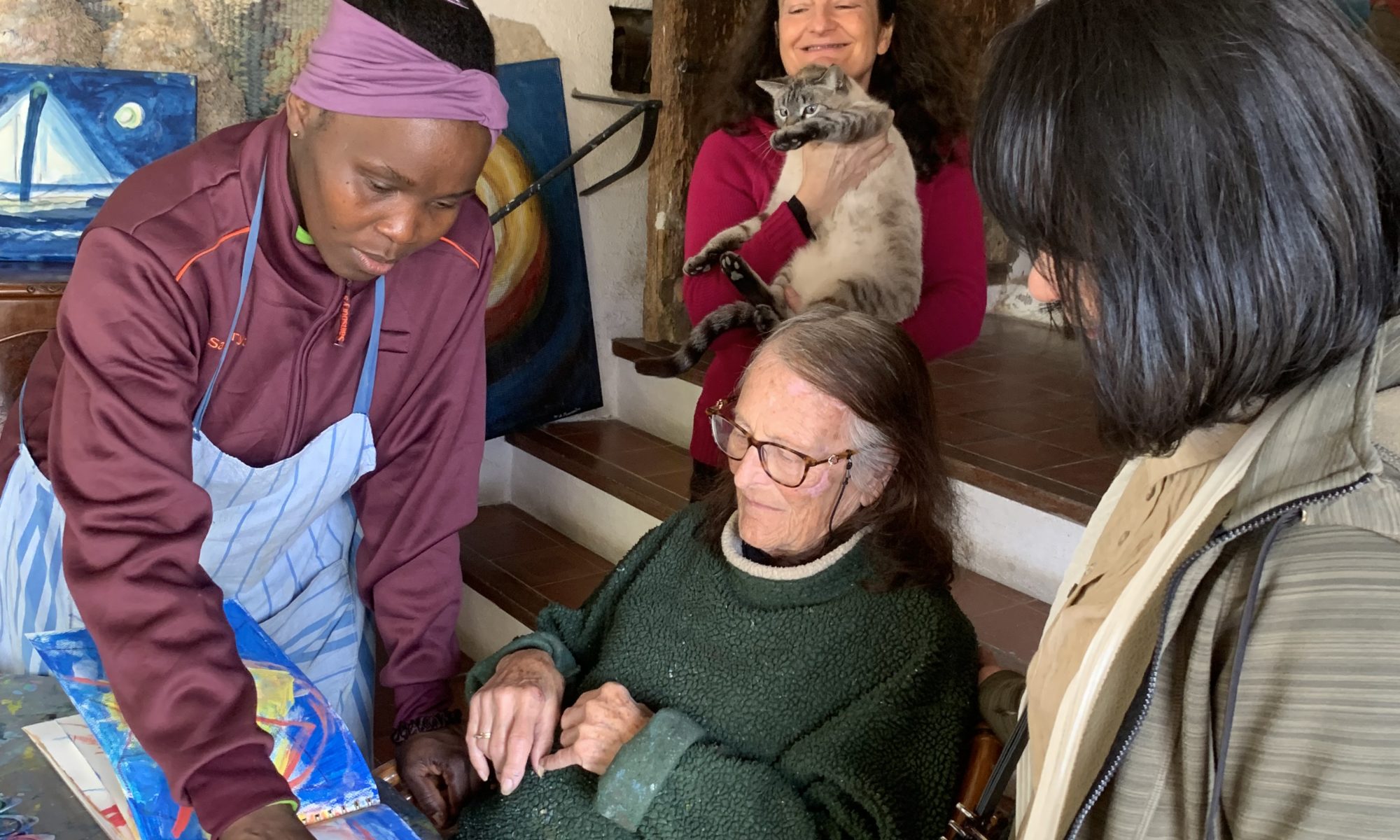
It was through this openness and spontaneous gateway that the trip unfolded. We shared beautiful moments like arriving at the family house and entering the atrium while Blanca’s mother, María Asunción Raventós, treasured Catalonian artist who is now 93, was quietly painting with her caretaker from Ghana.  (See photo)

Thank you Blanca for sharing the wisdom of your ways and the fun week in Barcelona.
Why Berlin?

Some days the answer is because it’s affordable. Some days the answer is because, why not? With an Irish passport, I can live and work in the EU. And a lot of days it’s the world-class art, green forest and local food scene.

But today, it’s because America is broken.

Of course being an American and moving to Berlin well into mid-life, this question gets asked a lot. And naturally, the story begins with a German boyfriend (Martin) many years ago (now, long an ex, and still very much happily married to his lovely German wife after 28 years). In my 20s I got to know Berlin from Martin, and over many years would make visits to get to know it better.

In 2017, to celebrate my 30th year as a public relations professional, I decided to take a sabbatical (yes, another boyfriend/partner plays a role here, too, that recent relationship went kaputt and I wanted to press restart) and live in Beginner’s Mind.

Martin came through with a great apartment to rent and my Berlin life began.

I enrolled in an Integration Course at the Berlin Community College and spent five hours a day for a year learning German with classmates from Afghanistan, Iraq, Pakistan, Vietnam, Syria, etc.

The process deconstructed my identity as an American, a PR professional, an art lover.

It leveled the playing field. I was at ground zero. No language skills, no knowledge of customs. I needed to come at communication from an open-hearted place with patience for myself and my classmates and we needed to find a way to make sense of the world through our long-word salad.

Then, a new work path was created through relationships, desire and fate and I landed a role as an international development/marketing director at a small independent German film company. Things were meshing.

And I started to notice my emotional make-up seemed to be running on a new operating system. I felt a seismic internal shift. Not only was there a new sense of aliveness but I somehow felt more human and less like a consumer.

This is a dense and complicated topic that I can’t unpack easily on a blog post but I do know that this past week with the tragic loss of life at Uvalde Elementary school and the evidence that is coming forward about the police force deliberate delay has reinforced the fundamental feeling I have that America is broken and not a place I want to live, at least for now.

Systems are failing. Values and character are fading. Violence is random and repetitive.

UK based John Kampfner has written an award-winning book that takes the reader through my real answer about to Why Berlin? “Why Germans Do It Better. Notes From a Grown-up Country.”

Here is a comment from his website that sums up the book (and my personal experience and belief) “No country has caused so much harm in so little time. No country has achieved so much good in so little time. As much of the world succumbs to authoritarianism, as democracy is undermined from within, Germany stands as a bulwark for decency and stability.”

And that’s why, Berlin.

I Love Rutabaga

Rutabaga is like the last kid to be chosen for kickball. It’s not a vegetable that typically evokes emotion but when I was a child I became a super-fan. My grandmother BeBe, from Ireland’s County Kerry, served it in a rough mash, braided with butter, seasoned with lots of salt and pepper.

I know it’s unusual at Sunday supper to lust for rutabaga instead of mashed potatoes but I appreciated its bitterness and crunchy texture. It had more flavor, somehow. I didn’t understand it as complexity at the time. All I knew was it was both sweet and bitter and that it was dynamite when I had it with her caramelized pieces of lean pork roast.

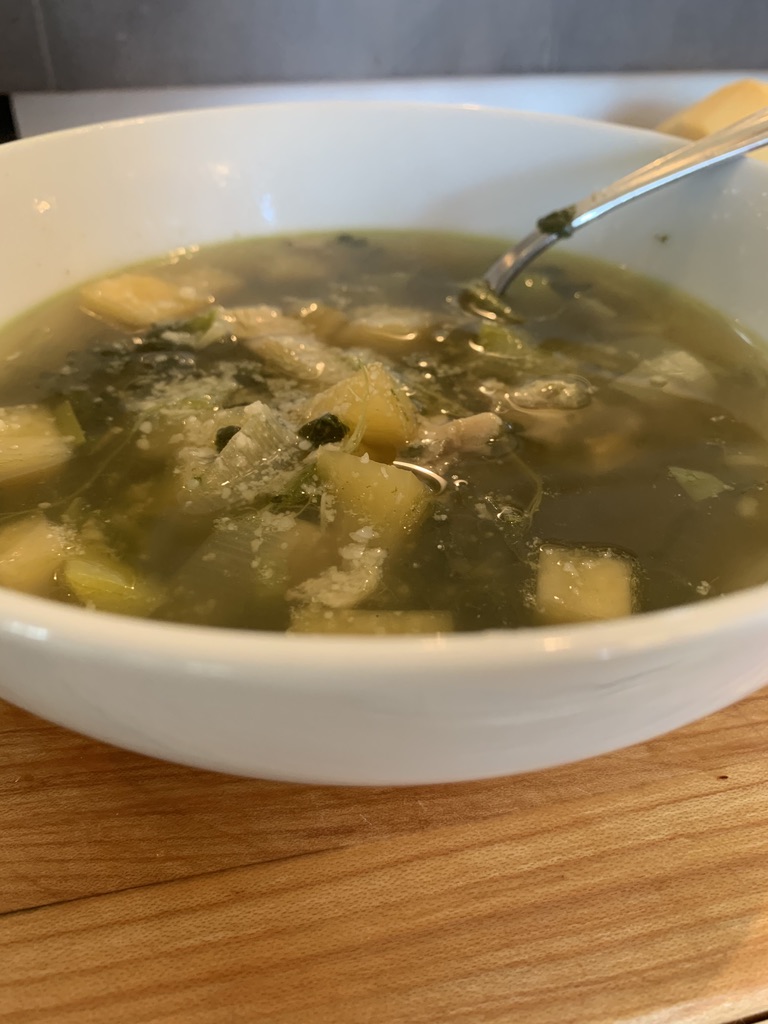
The other day, I noticed a purple and orange root settled next to the mixer on my bread rack. Its waxed skin wrinkling. I was making homemade chicken stock and I thought, hmmm. I wonder if I could dice that and add it to the leek, chicken, and kale soup I was winging?

Earlier in the day I had watched Alton Brown’s video on making chicken stock, because the few times I have made it, I never wound up with something that had any savory depth of flavor. With no real plan for the stock other than adding what was in the crisper to make some soup, it occurred to me I could chop up the rutabaga and toss it in. But, I have never had rutabaga in soup. I wondered, was there something terrible that happens when you add this modest tuber to soup? Does it make it unpleasant? Add off-flavors? Makes it watery?

The stock simmered for six and a half hours. The whole house was scented with roast chicken, onion, carrot and bay. Once chilled, and after a night in the refrigerator, the stock was the epitome of a well-made fancy hotel bed – layers of crisp sheets and bedding combining to provide a luxurious foundation. Definitely worth the risk of tossing in rutabaga. And now I may have something new to crave on Sundays.

Rutabaga, Kale, Leek and Chicken Soup

4 servings

Ingredients

2.5 quarts chicken stock (half of Alton Brown’s recipe, i.e. one chicken carcass instead of two) https://www.foodnetwork.com/recipes/alton-brown/chicken-stock-recipe-1914051

1 tablespoon butter

1 medium sized leek, cut off the dark green part, thoroughly clean, halve length-wise and slice cross-wise

I bunch Lacinato kale, washed. Cut off the stems and slice into half inch strips

I half medium sized rutabaga, peeled and diced into half inch pieces

8 ounces pieces of chicken, torn into small pieces

1/4 serrano pepper, seeded and diced into small pieces

¼ cup dry vermouth

Half cup grated parmesan cheese

In a medium size sauté pan, over medium heat add the butter. Once melted, add the chopped leeks and sauté for 5-7 minutes until softened and lightly browned. Remove from heat.

Pour the chicken stock into a pot and put over medium heat. Add chicken pieces, leeks, sliced kale, diced rutabaga, serrano pepper and vermouth. Season with salt and pepper to taste.

Cook over medium heat until rutabaga is tender but not mushy (approximate 15-20 minutes). Ladle into bowls and sprinkle with parmesan cheese.

Thoughts on Sound in Crisis

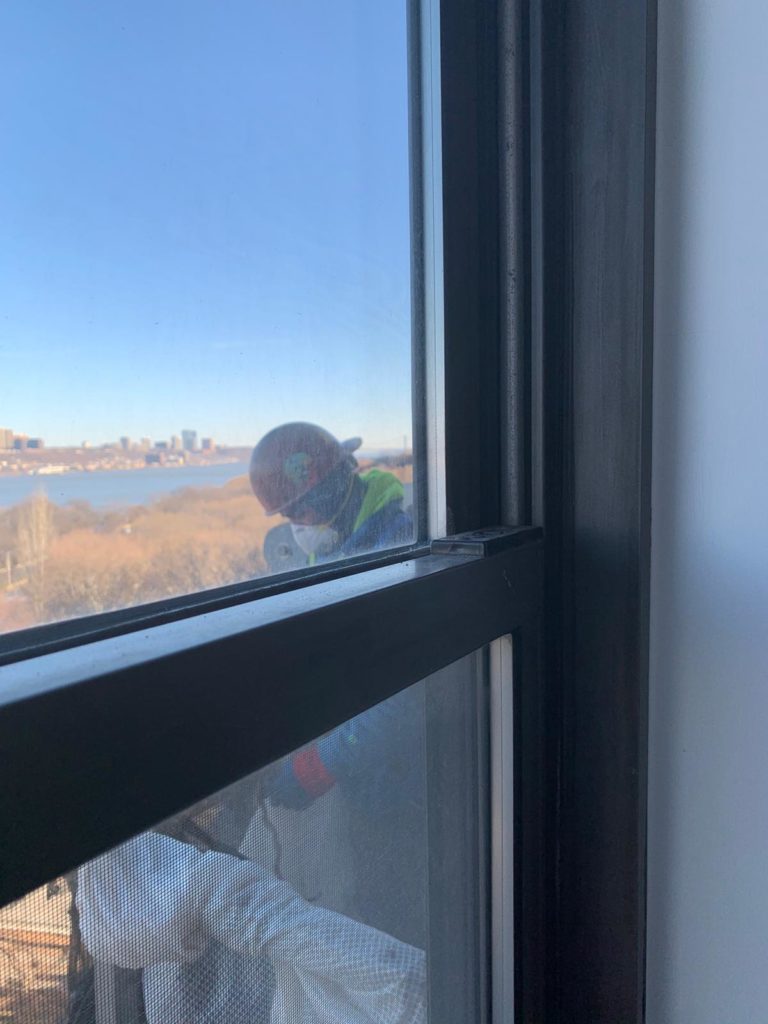
Mason workers started today at 8 AM outside my window to continue their work pointing the building. It was the sound of normalcy and I loved every high-pitched humm.

I remember the silence in Greenwich Village on September 11th, 2001. No honking, no braking buses, no street chatter. The quiet at Berlin’s Tegel airport on Friday, March 13th was familiar. We stood solemnly in lines snaking around the airport to check luggage and go through passport control. Transactions took place at whisper level. 

The most powerful silence lasted nine hours. No one talked on the flight to Newark. Suffering babies blasted us with cries but that was it. We were glued to our screens, sanitizing our seat-backs, washing our hands, quietly panicking as we prayed to arrive safely into a new normal. 

But today, as I was awakened by the sound of granite grinding at the hands of workmen outside my bedroom, I felt a sense relief. Typically, I’d be pissed. How could I be the lucky one to have my line of apartments worked on just as the 14-day self-isolation was only in its 3rd day (since I traveled from Germany, I’m in this camp)?

But I feel comforted.

The COVID-19 crisis is so terrifying that the loud grinder noise is welcome. These are guys just doing a job on a Monday morning. The work means they will get a paycheck. It means things are not all grinding to a halt. 

The B. Smith Controversy, Why Her Grey Hair Matters More to Me Than Her Husband’s Girlfriend

I booked Barbara Smith on her first Today Show appearance in 1995 when I was working as her publicist. I remember standing next to her as she whipped out that famous pink and green mascara and nervously added another layer to her sparkling eyes. There was never a moment when her smile and beauty didn’t stop you in your tracks. And there was never a moment when I was with her when her loving, devoted husband wasn’t either with us or calling to check in.

Now Barbara is six years in to a battle with Alzheimer’s that she and her husband chose to make public. Before the disease had taken too much a strong hold on her, she and her husband co-authored a book about the challenges associated with the disease and they made many public appearances together to show the world what it looks like to love a spouse who is fighting this wretched disease.

Like so many who have weighed in on this topic, I lost my maternal grandmother to Alzheimer’s in 1987.

The Washington Post article that ran a story this week about Dan and his new part-time-live in girlfriend has stirred up many questions about what love looks like for the patient and the partner. However, for me it’s not an unconventional trio in the house that hurts my heart.

It’s the lack of lipstick on Barbara’s lips and her grey hair.

I get it. Dan is tired, remains firmly committed to Barbara but also wants a full life and to be loved by someone who is able to be fully present in a way that Barbara is no longer capable of. But I find it horrific that no one – Dan, Alex (his girlfriend), their daughter or anyone else who was in their house the day the companion video for the WaPo story was shot, didn’t stop and say “Hey, we need hair and make up. This is Barbara Smith. She is the second black woman to ever be on the cover of Mademoiselle Magazine. Let’s honor her and who she is/was and make up this gorgeous woman in a way that shows the world how beautiful she still is – despite being a victim of this ugly disease.”

Why isn’t someone connecting those dots?

Loving someone includes continuing to honor that person’s dignity. It is complicated to see a married man with his girlfriend and his wife all smiling and being affectionate. I don’t think it’s the triangle of love that’s a bad optic for Dan. I think it’s simpler than that. Put some gorgeous lipstick on that beautiful woman while you continue your caregiving and your Facebook posting.

The Three Rules to a Great Working Relationship with Clients

Creativity, Chaos and Kindness

Last week we had a kick-off meeting with new client Grön Chocolates from Portland, Oregon. We covered our scope of work, the immediate and long-term goals, our communications systems and holiday plans. All the typical things in a first client call with the whole team.

I wrapped up the call by asking if there were any other thoughts. “Does anyone want to share any final questions?”

The marketing manager answered. “I move really fast. I have strong opinions. Feel free to stop me and ask me to slow down and clarify.”

I love that she has the self-awareness to know how she shows up in meetings and that in some cases this might get in the way. And this opened up a whole new topic which is how best to work with marketing communications agencies.

Here are my three rules for a happy and results-oriented agency/client relationship:

Lead with Creativity – Templates are fine and they certainly add value when one needs a plug and play program but the joy in our work comes from seeing connections that are fresh and haven’t been done before. We seek clients who don’t balk at risk. Our approach is to build strategy into the creative ideas but have fun and go a tad over our ski tips so we can partner with clients and open up new worlds, new markets, new revenue streams.

Chaos  — While having systems in place is ideal, we also realize that start-ups are bound to have inherent chaos in their day–to-day work. We set up expectations that we will be an external “organized assistant” helping with project management. However, chaos drives creativity and that discomfort is okay by us. As long as we’re clear in our communication with the client and checking in regularly, we thrive on the messy, darkness of the unknown because we’ve learned in the start up world that the bigger the idea, the more time it takes to completely understand the scalability and possible category disruption.

Kindness What does this mean in client relationships? I don’t mean don’t be rude or disrespectful. Those are “no brainers.” I mean be honest in a gentle way. I’ve seen so many working relationships go south because agency reps don’t have the confidence or know-how to say what they’re thinking if it contradicts the client’s plans. Once trust gets built, and we try to build it from day one by bringing integrity into the relationship upfront, our goal is to keep it real. Share real feedback on the products from media. Be frank about ideas, graphics, flavor profiles, whatever. There is a kind way to collaborate and be truthful. The best work comes from relationships that are built on honesty and kindness – not always easy to do in a city like Portland known for its Passive-Aggression culture, lol, but it’s our daily practice to bring this as a guiding principle into our working relationships.

Eating a Fish Head

Eating a Fish Head, Learning About Seeds and Having a Spiritual Re-centering at The Oxford Food Symposium

I’ve been experiencing moments in my career that I find disheartening. It could be the common mid-life crisis. Now that my career is as old as a senior millennial (31 years and counting), I continue to have many, been there, done that moments. But I think it’s more than that.

The generation gap that separates seasoned marketers, entrepreneurs, authors, makers, etc. from the “Instagram influencer” widens each year. I do enjoy the democratization of the sharing economy and the access it provides to learning about food culture. But my personal experience within the social media “documentation” of food exploring, aka my late night Instagram feed check before bed, often leaves me asking the question, “Who cares?”

It’s post after post of Ramen shots and well-garnished cocktails discovered in Iceland or some dive bar in Queens.

I find it soul crushing that experts who take years and years to hone a craft sometimes struggle to pay their bills because they haven’t mastered the art of content strategy and social media. Now, I realize the irony here. Some of my own expertise focuses on helping clients navigate the challenge of becoming a leader and building out a platform and certainly our work involves content strategy. Yes, I am the kettle calling the pot black. But….

I found an antidote to my social media depression:

An invitation to attend the Oxford Food Symposium by its Director, Ursula Heinzelmann, (one of the greats!) which led to an incredibly healing three days being in scholarship with 230 experts and enthusiasts. It was a full-on immersion into knowledge for knowledge’s sake. Context, history, questions, stories and community took center place. Complex subjects and histories were explored through rigorous research. I was honored to be learning and sharing ideas with this group.

I didn’t realize that I was having a deep spiritual re-centering until about a month after the conference.

The Oxford Food Symposium is the longest running food conference in the world and it’s designed to create an all-inclusive academic sharing of ideas around an annual theme. This year’s theme was SEEDS.

During the conference I felt open and happy in a way I haven’t for years. There was a purity within the exchanges. We were free from business, sales, marketing and brands. We were a tribe where everyone at the table was a Shaman.

The most remarkable moment was eating my first whole fish head. London-based Ukranian Chef Olia Hercules prepared a highly fragranced broth (mostly dill, millet and garlic lyok) and served the humble head as the main star. My dining companions were Elizabeth Hoover, Manning Asst Professor of American Studies of Brown University  and Sean Sherman, CEO and Founder of The Sioux Chef and they approached the fish heads with a fluency that was inspiring.

Elizabeth became my fish head-eating mentor. She taught me to tackle the eye as the first bite since it’s the most coveted piece. I had to force myself to pick it out of socket and place it into my mouth. The first sensation was the eye-ball casing. It was like accidentally getting a piece of saran wrap in your mouth. Then I tasted the gelatinous material of the eye and finally spit out the hard white center which isn’t edible.

Next to me I watched Elizabeth as she consumed her fish head like it was the taste of young love. There was speed, slurping and gusto and then pop there was a super tiny pile of bones on her side plate. Every ounce was devoured.

The extraordinary meals and kinship at the table were memorable but the real treat was absorbing the 20 minute talks on a wide variety of topics related to seeds. (Each symposiast gets access to the full academic papers prior to the Symposium). Highlights for me were learning about the Svalbalt Global Seed Vault, the history of buckwheat in Brittany and the tradition of coriander in beer.  Shameless client plug here – I also loved David Asher’s presentation on natural cheese making.

There was true beauty in the slowing down, in the old-fashioned exploration of a subject, a question, original research and the sharing of the findings. Now that I realize there is a place for me to “worship” and have fellowship such as the Oxford Symposium, I have lightened up a bit about my prejudice against the endless sea of photos and visuals celebrating food. The most powerful impact of the Symposium on me has been a reawakening of my own youthful energy and joy for what got me into this whole thing in the beginning, my love of food.